My Great Grandmother Billy suffered from Alzheimer's until the time of her death. This blog is in memory of her. I hope that the information provided here will help those suffering be prepared for the trials of the disease, and for family members of Alzheimer patients to care for their loved one. This blog is for anyone who would like to contribute and tell their story in dealing with Alzheimer's disease. If you would like to contribute please email me. alzheimersperspective@gmail.com

STORY TIME Helps Alzheimer's Patients Retain Communication Skills

Linda White (left) leads a session based on a program called TimeSlips at a Seattle senior center. The idea is to show photos to people with memory loss to help them make up a story.

'Story Time' gives Alzheimer's patients a new way to communicate. As many family members and caregivers know, it is frustrating for patients with Alzheimer's to try and have conversations. This is largely because most conversations rely on the ability to remember facts or past events. When people with Alzheimer's are repeatedly faced with the frustration that they cannot remember things, they tend to avoid conversation and can lose most of their previous communication skills.

Caregivers are now using story time as a means to have active communication between patients and improve their overall demeanor. This story by NPR highlights the success of this approach and how easy it is to do at home with loved ones.
So what exactly is story time? It can be as simple as grabbing a picture and asking "What do you think is happening here?" There is no right or wrong answer and allows your loved on to be able to communicate and interact in a low threat scenario.

For the full article, click on:
http://www.npr.org/blogs/health/2012/05/14/152442084/alzheimers-patients-turn-to-stories-instead-of-memories

Government/ NIH sets 2025 Timeline for a Cure

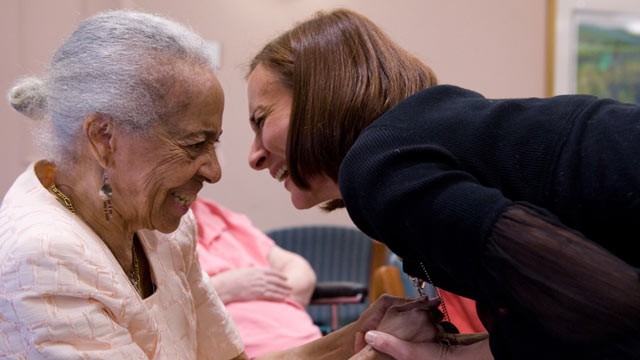
PHOTO: Music therapist Heather Davidson (R) embraces June Thorne after holding a drum circle with patients with Alzheimer's disease at the Copper Ridge Care Center in Sykesville, Maryland, on October 23, 2009.

NIH has just announced a full fledged campaign to combat Alzheimer's disease and help those 5.4 million American's suffering. More money than ever before will be given for researchers to find better treatments by 2025. Most treatment options right now focus on treating the symptoms after the onset of the disease. With the new campaign, money will help researchers not only tests medications that treat the root cause, but also help those with genetic markers for early onset Alzheimer's (starting in the late 40's). One of the latestest breaking treatments starting to be tested is the insulin nose spray to stimulate short term memory. In addition to this, a new website www.alzheimers.gov is just released for more information for caregivers and patients looking for trial studies and help in dealing with the disease. See the full article at ABC news at http://abcnews.go.com/Health/government-aims-end-alzheimers-disease-2025/story?id=16351834#.T7MwDsXd8ud
Be Apart of the Longest Day
On June 20th the Alzheimer's Association will be having the Longest Day Event. A team signs up and 1 member of your team will be doing some sort of endurance activity during all 24hours of the day. Its a fantastic way to take a stand for Alzheimer's and increase healthy living activities. Click on the link for More information.

Laughter is the Best Medicine


Anyone who has been around a loved one with Alzheimer's knows how agitated they can get at times. Any little thing can lead to rapid frustration. Often times, the trigger is confusing themselves or their caretaker doing something they don’t understand or approve of. Anything that helps the patient be in a more light-hearted mood is a true blessing for care givers and family members. I recently found an article showing that Alzheimer's patients increased their moods by as much as 20% after viewing entertainment that made them LAUGH! - Read more about how one man brought joy to elderly patients!

Laughter-Good-Medicine-For-Dementia

Increased physical activity wards of dementia!


New Research shows that study participants having a higher level of daily activity have less risk for developing dementia. This study looked at participants over the age of 82 for a period of 4 years with varying levels of physical activity. The subjects with less risk did not necessarily have to actively exercise, but merely showed a more active lifestyle overall. Furthermore, a similar study showed mice who chose to be active were retained more cognitive abilities than less active mice.

To see the full article from msn and another similar study click on the links below!

Full Article from MSN Health News!

Physical Activity Lowers Risk for Alzheimer's

11 Preventative things to do for Alzheimer's now!

According Jean Carpers New book"100 Simple Things You Can Do To Prevent Alzheimer's", these are 11 preventative steps you should take against the disease.

1. Apple Juice
2. Cinnamon
3. Coffee
4. Education
5. Socialize
6. Perserve your vision
7. Meditate
8. Mediteranean Diet
9. Relaxation
10. Less Sugar
11. Take care of your gums

For the Original Article and more information go to:
http://www.foxnews.com/slideshow/health/2010/09/15/ways-ward-alzheimers-disease/#slide=2

Dr. Oz focuses on Alzheimer's

Dr. Oz did a great segment on his show focusing on Alzheimer's disease. He spoke about the importance of early diagnosesis and addressed risk factors and foods that help prevent Alzheimer's. Here are a few of his main points.

Risk Factors:
1. Memory Loss that disrupts daily life.
2.Genetics (mainly in early onset Alzheimer's).
3.New Problems with Words.
4. Misplacing things on a constant basis.

Prevention:
Aerobic Workouts (10 min per day)
Mind Workouts(cross word puzzles, reading e.t.c)
Healthy Foods
-Curry, Olive Oil, Folic Acid, Vitamins B12 and B6, Antioxidants

Find out more at doctoroz.com and take his memory test at http://www.doctoroz.com/quiz/memory-quiz

Ella Ragland Art

This program is so unique I thought that it needed its own posting!
In 2005, I took early retirement from academia to start my own company, wherein I sell prints and cards made from Mom's art work. All of our company proceeds pay for therapy for Alzheimer's victims. We are blessed to have a new music therapy program at Drury University, and I've given grants to the first two grads. Music, as applied by a trained therapist, reaches through the Alzheimer's affected brain and brings pleasure to the victim-patient. It is amazing. Our first company grant was only $500, because my company is small and raising funds is very hard. But this grant provided pallative care for two end-stage Alzheimer's victims.

Jane Doe, age 65, loved music, and when first admitted to the care center, participated with every sing-along. By 2005, she was ambulatory only in a Merry Walker, could not speak, drooled, her hands were gnarled and usually in her lap, couldn't -or wouldn't hold her head up. Passive. The first music therapy session got minimal response and she seemed almost afraid of the therapist. By the end of 6 weeks, she was keeping her head up for the full 30 minute session, trying to sing and reaching for the keyboard. That in itself, was a $500 moment!!

Betty Doe, age 92 loved music, was in a Merry Walker, and very active. She pushed that thing all over the ward. She talked, but the words were in an order you couldn't often figure out. She said "um hum" lots, and her hands were active, often unbuttoning her blouse or reaching for the therapist' hands. It was difficult to tell if music therapy changed her much. It was clear, however, that she enjoyed the sessions.

Thanks to the 2008 benefit for the company sponsored by MacCreed's Art Gallery, I had $1500 for another grant that extended fall 2008-Feb 2009. This time, we took the therapist to a facility where we had a group of mild-to-moderate Alzheimer's victims. Again, the effects of music therapy were obvious and powerful. The administrator, staff, and family members have asked us to come back as soon as possible. As one family member wrote, "This therapy is so needed for this frailty... yes, please continue."
To hear more about this program or to let them know what a great job they are doing, go to http://www.ellaraglandart.org/

"Pump Organ"

Joyce is an amazing woman who is using Art and Music to aid in the cause of Alzheimer's. Here is her personal story.

It is really amazing, and a little frightening to find that almost everyone I talk with has either a family member or friend diagnosed with Alzheimer's Disease! The victims are especially needy and so often neglected. Working in nursing homes is ... difficult for me, especially when I go to the one where Mom spent the last two years of her life wearing an ankle bracelet in a locked ward. Terrible. It breaks my heart to hear nursing home staff tell me that often - OFTEN - family members are virtually abandoned, once confined for care.

The last time Mom was out, I took her "down home" to the Hough chapel on Memorial Day 2002 where she played 4-5 hymns perfectly on the pump organ. (picture above) Then, she turned around and didn't know where she was, or who I was, or her sister and cousin standing beside her. Music reaches through the plaque-filled Alzheimer's brain in mystical, magical ways.

"Bonds of Love are Eternal"

Posted by Susan

This past year I lost my Mom. Her body may still hold on for life, but the vibrant woman with sparkling blue eyes who loved to laugh, is gone. Alzheimer’s disease has erased her memories of a life well lived, full of people she loved.

When Mom’s condition began to deteriorate, she became very confused and frightened of everything. She would wake up in the middle of the night and panic because she did not know where she was, or how she got there. One of the worst days was when she realized that her husband had died, and relived the pain of loosing him all over again. It was heartbreaking.

Mom now exists in a foggy world with a few jumbled memories. Occasionally she recognizes me, but I don’t think that she recalls any of our shared memories. If someone you love has Alzheimer’s, go with them on their difficult journey. Pray for courage, compassion, patience and a heart full of love. Hold their hand and reassure them that they are ok. Always remember that they love you – even when they can’t tell you. Bonds of love are eternal.

Susan